
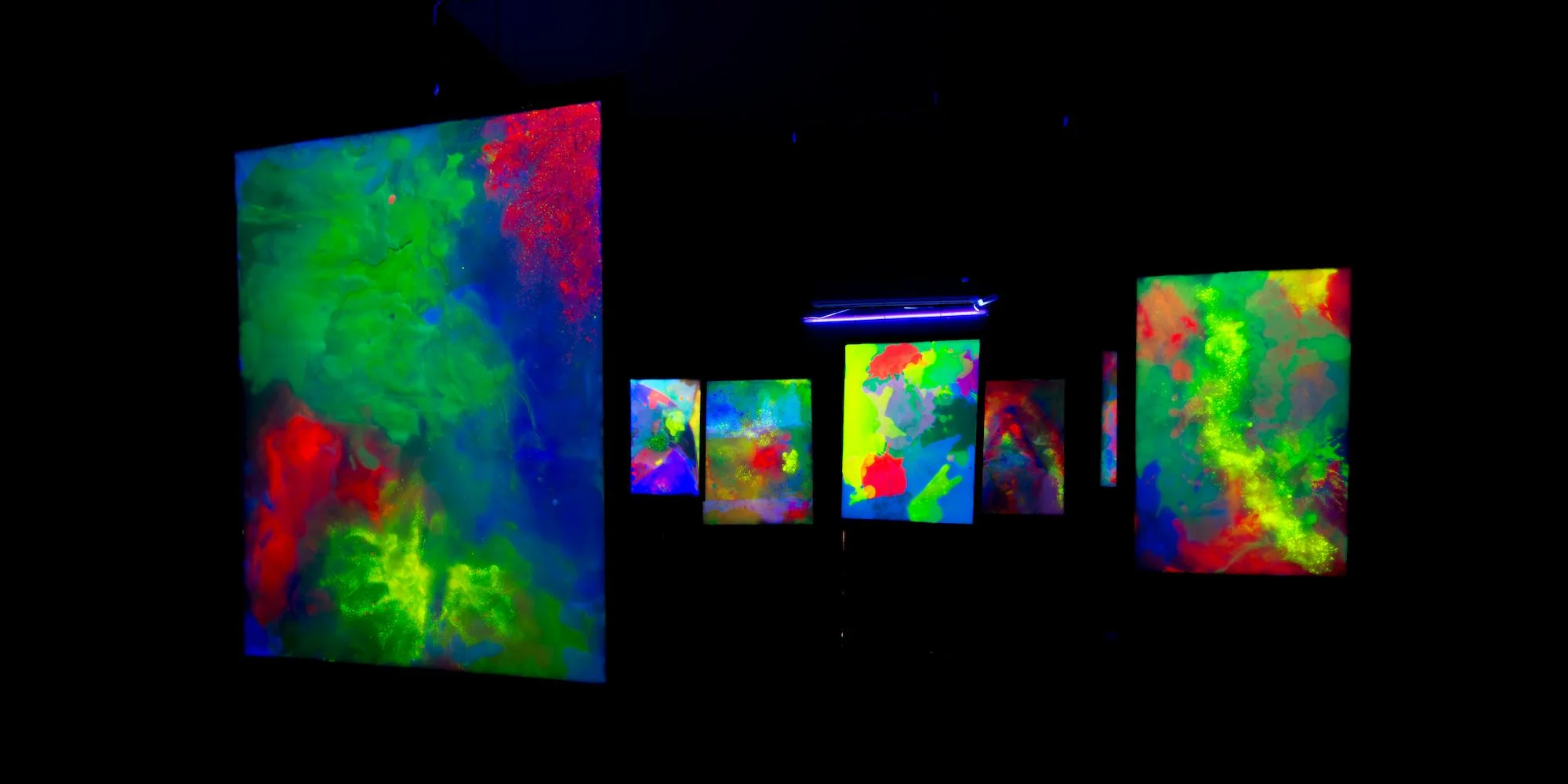
Most people think of darkness as an absence. For me it is where colour begins.
I work with fluorescent colours. In daylight they can look ordinary. Place them in a dark room, under ultraviolet (UV) light, and they come alive. They glow in a way that ordinary colour cannot. The darkness is what lets them be seen.
That idea sits at the centre of everything I make: light is nothing without the dark, and opposites are at their best when viewed together.
Darkness is often misunderstood
Darkness is often disliked, even feared. We label it as empty or evil. But darkness is what shows us the beauty of light. Without it, the vibrance of the colours we love would have nothing to stand against.
The universe works the same way. Billions of suns, moons, planets and galaxies shine because they are surrounded by darkness. Take the dark away and none of that brilliance could be seen.
Where it began
My fascination began in Dir, my ancestral home in the north-west of Pakistan. I grew up between Islamabad and Dir, and the night sky there is so clear that it looks as though glitter has been scattered across a dark backdrop, glowing. I have always looked up at it. What troubled me, even then, was how easily something so beautiful is taken for granted. Caught in busy urban routines, few of us take the time to look up, and in many places light pollution means the stars can barely be seen at all.
Years later, I lay on a beach at 3am with a friend. There was no one else there and no light of any kind. The darkness was complete. As we watched the stars, they seemed to move and dance with the sound of the waves. It was surreal, unlike anything I had experienced before.
What stayed with me was how each star looks like a single dot, yet holds so much more. That idea, of the point that contains the infinite, still runs through my work, from Cosmic Nuqta’s Ark to Nuqta In Rotation. It also left me with a question: what could glow in the dark the way those stars did?
How this shapes my work
I began to experiment. I started with neon fluids, in which two components glow once they are mixed, but the glow fades after a short time. I moved on to fluorescent pigments, which glow for as long as ultraviolet light falls on them and disappear the moment it is switched off. Then I worked with phosphorescent powder, which stores natural light and releases it slowly as the room grows dark. Each material behaves differently and asks something different of the space and the viewer. Today I bring them together in my work as each piece requires.
In Productive Procrastination (2016), an immersive environmental installation in an actual generator room, I used neon pigments with no other light at all: just a dark room and the glow of the pigments. I photographed the space as it appeared in the dark.
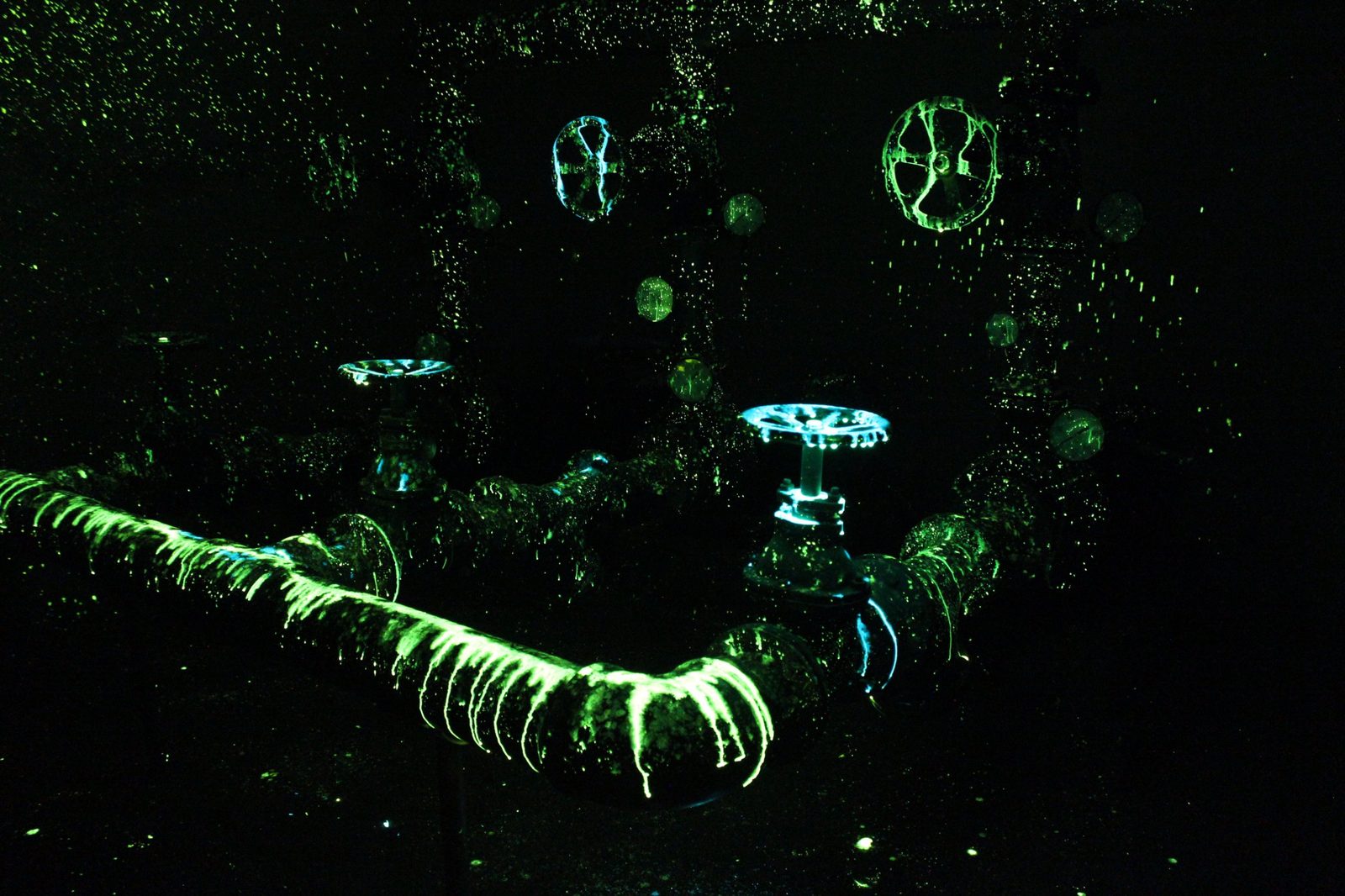 Productive Procrastination (2016), immersive environmental installation by Javeria Salar in a generator room. Neon pigments, no other light.
This curiosity about light, movement and perception goes back to my graduating thesis at the National College of Arts, which investigated the psychological effects of light and movement within sculptural environments.
In my series Transcendence (2015), I combined beeswax with neon fluid and fluorescent powder in encaustic paintings lit by UV light. The pigment sits within the wax, so colour becomes part of the substance of the work and, under ultraviolet light, takes on a heightened intensity. These works were an early expression of concerns that still run through my practice. In Infinite Universes and Celestial Orbits, geometry and pattern carry the same question: how do we perceive something so large that we cannot hold it in our minds?
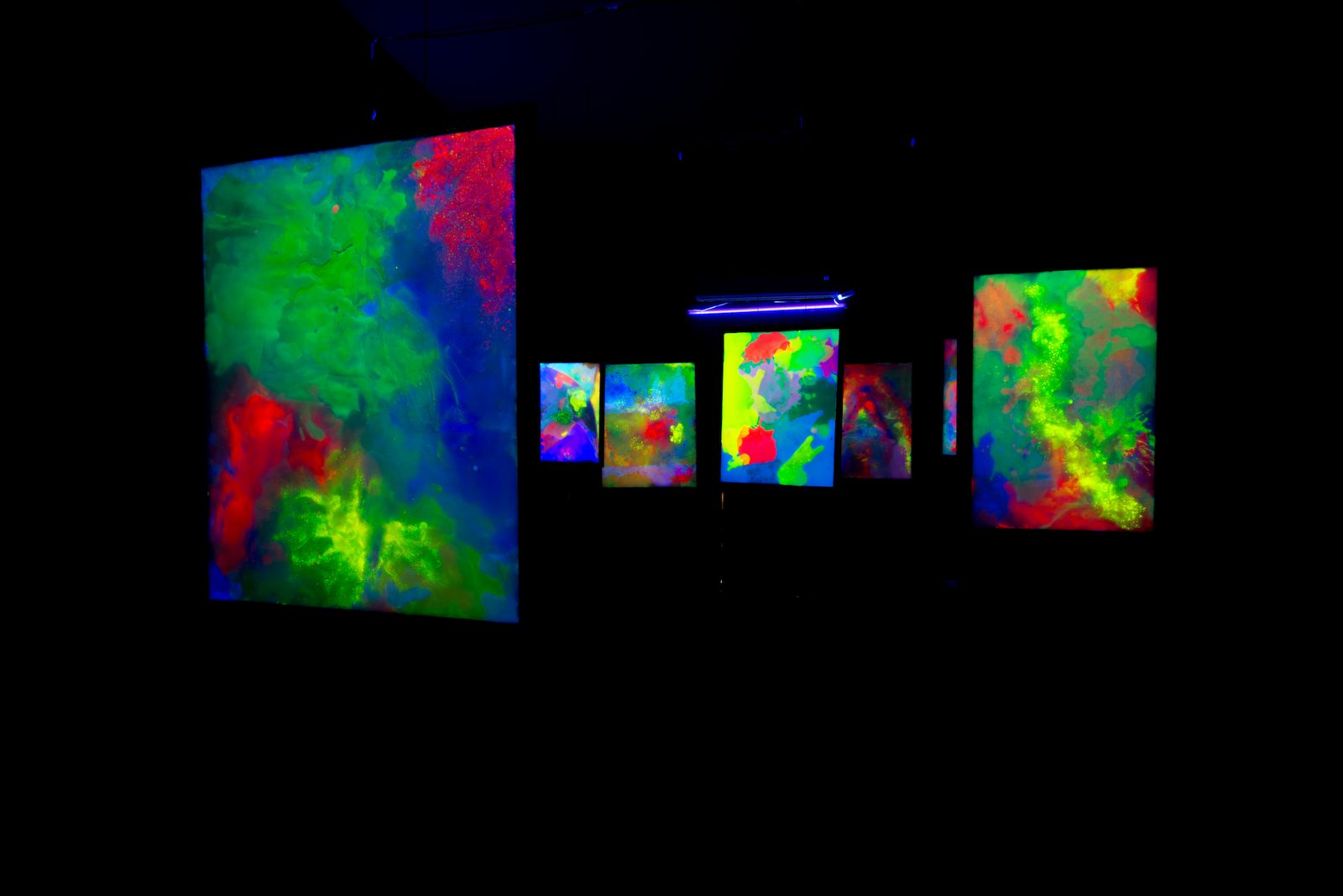 Transcendence (2015) by Javeria Salar: encaustic paintings with beeswax, neon fluid and fluorescent powder, under UV light.
I do not try to explain the universe through my art. I try to create a moment where you pause, let your eyes adjust, and feel your place within something much bigger.
See it for yourself
You can view the full series on my Artworks page. If you would like to know about future exhibitions, visit my Exhibitions page or get in touch.